Choosing a supplier for custom hats, patches, drinkware or promotional products is about more than finding someone who can make the item. Your supplier becomes part of your production chain, and their communication, consistency, capacity and quality control can directly affect your deadlines and the experience you provide to your own customers, employees or organization.
The short answer: vet a supplier by looking at what they make, how clearly they communicate, whether their capabilities match your project, how they handle timelines and problems, and whether their track record supports the promises they make.
Why Supplier Vetting Matters
A low price or attractive sample can get a supplier onto the shortlist, but neither tells you how the relationship will perform once an order is in production. For repeat orders and larger programs, reliability becomes part of the product.
If an order arrives late, decoration is inconsistent or communication disappears when something changes, the downstream customer usually experiences the problem through your business. That is why supplier selection deserves the same attention as product selection.
1. Confirm Who You Are Doing Business With
A professional supplier should make its business identity and contact information reasonably easy to understand. Look for a consistent company name, a functioning website, clear ways to contact the business and enough information to understand what it actually provides.
This is especially important when you are establishing an ongoing purchasing relationship. You should know who is responsible for the order and where to go if you need help.
2. Make Sure Their Capabilities Match the Project
Not every decorator or promotional-products supplier produces every process in the same way. Some work may be completed in-house, some may be sourced through production partners, and some suppliers specialize in particular products or decoration methods.
Ask what process will be used for your project and whether the supplier routinely works with the product, material and artwork involved. A shop experienced with laser-engraved leatherette patches may evaluate artwork differently from a provider producing embroidered patches. Full-color UV printing introduces different considerations than laser engraving.
If you are comparing decoration methods, our guide to laser engraved vs. UV printed leatherette patches is a useful starting point.
3. Evaluate Communication Before You Place the Order
The quoting process often gives you an early look at how a supplier communicates. Are questions answered clearly? Are specifications documented? Does the supplier explain limitations rather than simply saying yes to everything?
Good communication does not mean receiving constant updates. It means knowing what is expected, what information is needed from you and how significant changes or delays will be communicated.
4. Ask About Turnaround the Right Way
“How fast can you make it?” is only part of the question. Ask when production time begins, whether artwork approval is required, whether the quoted timeline includes shipping and what happens if materials or production schedules change.
For deadline-driven projects, distinguish between a production estimate and a required in-hands date. If an event date is firm, communicate it before placing the order rather than assuming normal turnaround will work.
5. Consider Capacity and Repeatability
A supplier that can produce 25 pieces successfully may or may not be the right supplier for recurring orders of 250 or 2,500. Volume changes material requirements, scheduling, production time and quality-control demands.
If your program is expected to grow, ask whether the supplier regularly handles comparable quantities and how repeat orders are managed. Consistency becomes particularly important when products are reordered over time.
6. Look at Quality Control, Not Just Samples
A strong sample demonstrates what a supplier can make. Quality control helps determine whether that result can be repeated across the order.
Ask how the supplier handles placement, scale, color expectations, engraving appearance and inspection. For branded products, small inconsistencies can become much more noticeable when dozens or hundreds of pieces are viewed together.
7. Understand the Artwork Process
Artwork quality affects production quality. Before ordering, find out what file types the supplier prefers, whether artwork review is included and what happens when a logo is not production-ready.
Vector artwork is useful for many production methods, but a clean high-resolution raster file may also be appropriate depending on the application. Sending the best original artwork available gives the supplier more options than sending a screenshot or a compressed image copied from social media.
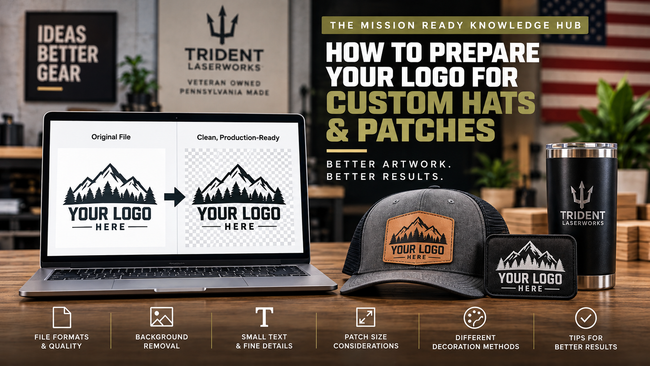
For more detail, see our guide to preparing logo artwork for custom hats and patches.
8. Check Reputation in Context
Reviews, customer examples and referrals can help, but evaluate them in context. One isolated complaint does not necessarily define a business, just as a handful of perfect reviews do not guarantee that a supplier is appropriate for every type of project.
Look for patterns. Comments about communication, consistency, turnaround and problem resolution are often more informative than a simple star rating. When possible, look for examples involving projects similar to yours.
9. Ask What Happens When Something Goes Wrong
No production operation is immune to equipment problems, material delays, carrier issues or human error. A useful measure of a supplier is not whether they claim problems never happen, but how they respond when they do.
Ask how production issues are communicated and how the supplier handles products that do not meet the agreed specifications. Clear expectations before an order can make difficult situations much easier to resolve.
10. Compare Total Value, Not Just Unit Price
Price matters, but it should be compared alongside the product, decoration method, artwork requirements, service, timeline and intended use. Two quotes that appear to cover the same item may include very different products or processes.
Our Knowledge Hub guide on why custom promotional product prices vary provides an apples-to-apples framework for comparing quotes.
Supplier Vetting Checklist
- Can I clearly identify and contact the business?
- Does the supplier regularly produce the product and decoration method I need?
- Are product specifications and expectations clearly documented?
- What artwork files are preferred, and is artwork review included?
- When does the quoted production timeline begin?
- Does the timeline include shipping?
- Can the supplier handle my current quantity and likely future volume?
- How is quality controlled across a production run?
- Are there relevant examples, reviews or references I can evaluate?
- How are delays, defects or production problems handled?
- What charges are included in the quote?
What Supplier Vetting Looks Like at Trident LaserWorks
At Trident LaserWorks, we work with businesses, organizations and individual customers across custom headwear, patches, Mission Ready drinkware, pens and other promotional products. Our in-house capabilities include laser engraving, full-color UV printing and textured UV applications, while other product categories may involve established production partners.
We believe the right solution starts with understanding the artwork, quantity, intended use, deadline and budget. Sometimes that means recommending a different decoration method or product than the customer originally expected.
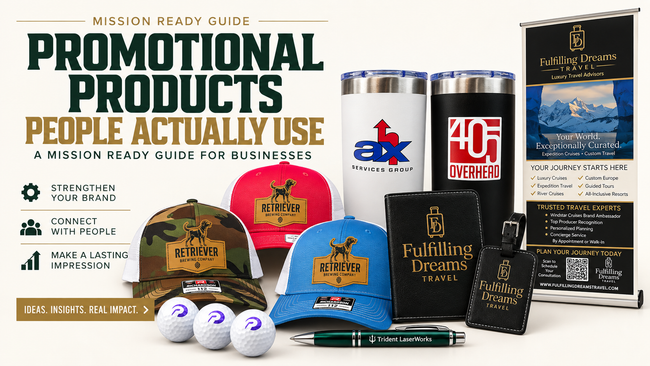
For larger-volume projects, visit our bulk order options. If you are still deciding which type of branded product makes sense, our promotional product selection guide can help narrow the options.
Frequently Asked Questions
What should I ask a promotional products supplier before ordering?
Ask about the exact product, decoration method, artwork requirements, minimum quantity, production timeline, shipping expectations, additional charges, quality-control process and how problems are handled.
How can I tell whether a supplier can handle a large order?
Ask whether they regularly produce comparable quantities, how they schedule larger jobs and how they maintain consistency across a production run. Past examples involving similar volume can also be useful.
Should I always choose the supplier with the best reviews?
Reviews are one useful signal, but they should be considered alongside capabilities, communication, relevant experience, product fit and the requirements of your specific project.
Should I ask whether production is done in-house?
Yes, when it matters to your project. In-house production and production partners can both produce strong results. The important questions are who is responsible for the finished product, what process will be used and whether expectations are clear.
How early should I contact a supplier for an event?
As early as practical. Artwork approval, production scheduling, material availability and shipping all require time. If you have a firm in-hands date, provide it during the quoting process so the supplier can evaluate whether the timeline is realistic.